Bonded and Free Trade Zones in China
Whenever it comes to international economic activity, one of the key issues is dealing with VAT and other taxes and customs duties in all possible variations. In particular, the requirements for the payment of VAT or duties might become the very stumbling block that would make the business model unprofitable. VAT and duties are unavoidable in a simple and straightforward import / export transaction, but other cases may offer wider room for maneuver. This article will highlight how and what has been done to facilitate business and trade in China.
In total, one can identify three main groups of special areas, in which the requirements for foreign economic activity and related processes are simplified in terms of taxes and duties. These are:
- free trade zones (自贸区). As for now, there are 18 FTAs in China, all established at the level of provinces or higher, but none having yet escaped the status of experimental. The main feature of such a zone is that it is not included into the vertical hierarchy of responsibility of China Customs Administration. Accordingly, despite being physically located on the territory of China, for customs purposes it lies outwards. The purpose is clear – for trade between third countries
- bonded zones (保税区). Nowadays there are hundreds of them in China, with different focus areas, created for different purposes, and with a bunch of delicate discrepancies, but their key feature is that they are within the vertical hierarchy of responsibility of China’s Administration of Customs, be it with a special status. The purpose is clear as well – to facilitate trade between China and other countries
- bonded processing zones (加工保税区). In principle, this is one of the types of bonded zones, which, nevertheless, has become so popular and in demand that it can be singled out as a separate item. The purpose is also clear – for the import of raw materials, processing and further export abroad.
In sum and substance, all of them were created with one goal – to simplify the work and give the opportunity not to get involved with VAT and customs duties for those whose goods are not intended for sale in China. A company established in one of the above zones is a full-fledged Chinese standard company with all the necessary documents for activities in the PRC, i.e. with a typical business license, typical bank accounts and seals, and so on; the ability to register as a Chinese legal entity in all services and on all platforms; dealing with this company is almost the same as with other Chinese companies. At the same time, this sort of a company has some of the benefits of being a foreign company. A kind of two-in-one arrangement. Or, as it is officially called in China – 境内关外 (inside borders, out of customs control).
It is ideal for import (进口) into China. You can import a batch of goods of any volume. Physically the goods will be in China within walking distance from Chinese logistics, with the possibility of hiring Chinese workers to process it, but without paying VAT and customs duties, with a further possibility of instant shipment across China and paying VAT and duties only for that part of the goods that is required in China at the moment.
This is a great option for re-export (转口). The goods are physically located in a Chinese port, with access to Chinese international logistics, but without the need to pay import VAT for the import and return it at the time of export. Any company from any country can sell goods located in the bonded zone to any other company from any country (or to a Chinese company residing in this bonded zone) without paying VAT and duties.
This is a good choice for export (出口). A bonded zone resident company can purchase goods from factories at a price that does not include VAT and immediately export it from itself (or for itself). Payment to the Chinese supplier is made from the basic account of the Chinese company (both in yuan and in foreign currency), without the need to go through currency control both when sending and when receiving money.
This is also an opportunity to combine different options. Trade within the bonded zone, between different bonded zones, processing zones, etc. occurs without import-export (进出口) and without customs declaration (报关单), but by endorsement (核注清单). That is, it is quite possible to collect goods from several bonded zones, bring them to yet another processing zone and export finished products – and all this with access to Chinese logistics, Chinese labor market, Chinese financial instruments, but without the need to import and export it and, accordingly, pay VAT, import and export duties.
There is only one downside, really. A resident company in a bonded zone cannot work with a transferable VAT. That is, it cannot either transfer it to other Chinese companies or return it when exporting. Therefore, when buying something at a VAT-included price from another Chinese company, instead of 专票 (a special invoice that can be used to transfer and return VAT), it is only possible to receive 普票 (a regular invoice that does not imply VAT transfer and return).
Let’s take a closer look. By and large, a bonded zone and a free trade zone have a lot of overlapping aspects, but there are also differences.
To work in the bonded zone, you must be a Chinese company-resident of this bonded zone, or a resident of any bonded zone (but then you will have to work through an operator company in this bonded zone). To work in a free trade zone, you must be a resident of this free trade zone, or any foreign company (working, again, through an operator company). An operator, or 经营单位, is a company that has received customs approval to work with such a warehouse.
Accordingly, upon arrival of goods in a bonded or tax-free zone, a customs declaration is not drawn, since there is no crossing of the customs border. What is produced instead is a document called 中华人民共和国海关进境货物备案清单 (Customs Entry Goods Filing List of the PRC)
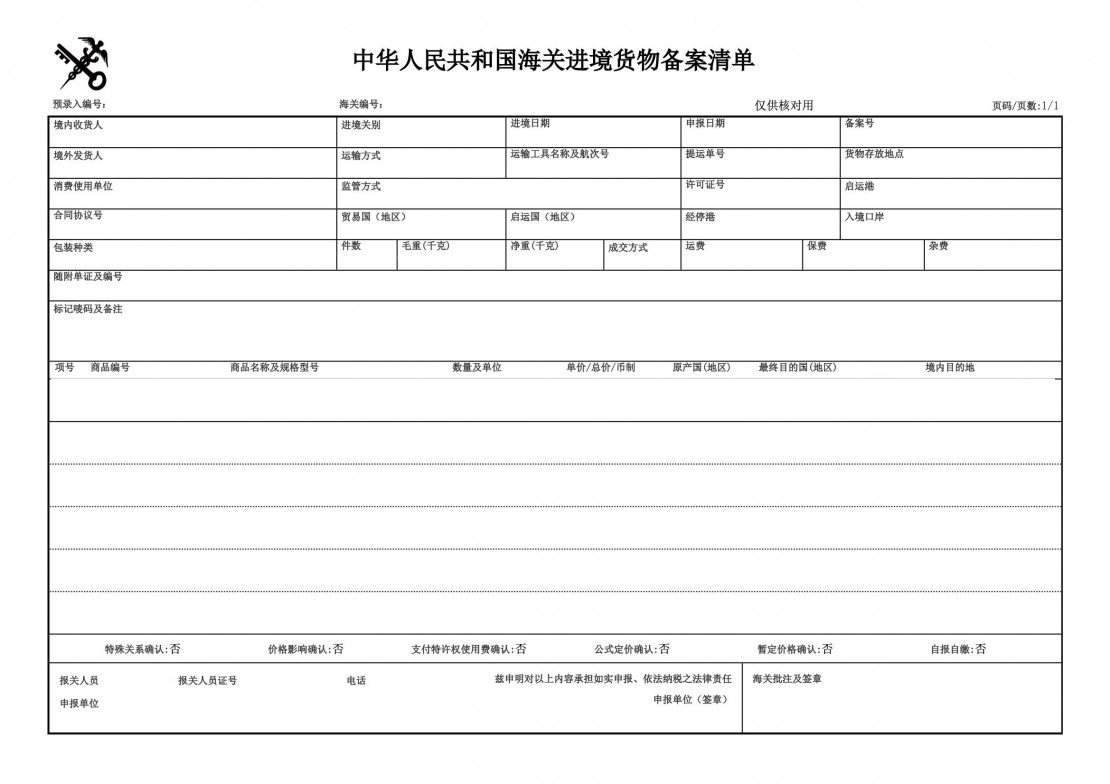
It is very similar to a customs declaration, except for the fields specific to bonded zones. Upon arrival of the goods, the company that owns the goods (a Chinese company in this or other bonded zones, a foreign company) must have a preliminary agreement with the warehouse operator company. Upon the arrival of the goods and the issuance of an import approval, the operator company provides the owner company with 货权证明 (certificate of ownership of the goods).
When transferring the goods between companies within the same bonded zone, or between bonded zones without importing into the territory of the PRC, 核注清单 (aka endorsement) is issued

These two documents are confirmation of the purchase of goods for the purpose of bank payments and other operations in which a customs declaration is provided in case of regular import and export.
One more thing that is not directly linked to this, but has a wealth of similarity is the concept of NRA-accounts. FTN accounts are opened in free trade zones for non-resident companies of the PRC for trade between third countries. That is, as with the idea of bonded zones / free trade zones, one serve for the trade of foreigners with China, whereas the other – for the trade of third countries among themselves.
Correspondingly, in the subsequent exporting or importing to China, when trading between China and its tax-free / bonded / free trade zones, everything happens exactly the same way as with the usual import and export.