Complaints and appeals to the state authorities of the PRC or 信访
Sometimes there are cases when your legal rights and interests are infringed upon. It doesn’t matter by whom – it may be a neighbour who arbitrarily decided to attach a balcony to their apartment. Or (as in the article) – when a telecom store refuses to issue a corporate SIM card. When neighbours litter the corridor with rubbish, car owners park on the aisle, and so on and so forth. Even, let’s say, when your rights are not infringed upon, but life is extremely inconvenient (for example, when you cannot get a ticket at the ticket issuing machine and are forced to stand in line at the box office). In any case, do not try to solve the problem by force and conflict – you will be the one to blame. In China, there is an excellent repressive mechanism for all of the above (and for many more cases). You just need to know how to use it, and the way to use it will be discussed in this article.
So, 国家信访局 (National Public Complaints and Proposals Administration) and specifically its service 国家投诉受理办公室 (Public Complaints Office) at http://wsxf.gjxfj.gov.cn.
It may seem that oral communication is the best solution. Indeed, the situation can be expressed verbally in much more detail and more comprehensibly, a sympathetic nodding person is sitting at the other end of the table. You do not need the skill to express your thoughts in writing, no registrations are required. Yes, all this is true, but there is one caveat.
“What is written with a pen cannot be cut down with an axe”. The proverb is exactly to the point. The fact is that any authority has criteria of success, KPIs, and so on. And if there are complaints, it means that they work poorly. This is the point of view of high-ranking officials. Therefore, no complaints equates to no problems. So, after your oral communication, they will forget about your problem as soon as you leave the office. By far, this happens not only in China, but all over the world. Simply put, oral complaints are just idle talk. While a written complaint (or, in our case, an electronic one) is an official document with an incoming number, a person responsible for processing, and so on. This is what sets the state machine in motion.
The folks up top are perfectly aware of this problem, and systems are being created to receive from the population those complaints that might be dismissed by public officers. We will talk about the Chinese version of such a system and its practical use in this article.
Understandably, specific complaints are accepted from a specific person. Or from several people (if the complaint is collective). Of course, there may be a case when a person is simply afraid to complain – anonymous complaints are also accepted (for example, on the website of the Beijing branch, you can submit a 匿名 (anonymous) complaint).
Moreover, it’s advisable to grasp the difference between the types of complaints. Although it is worth complaining about the crazy car owners (and everything also goes through this service), it is better to utilize Wechat Public Account 曝他 rather than this website. This is, in fact, a wrapper for filing complaints through the same service with one difference.
If submitted through the platform of the website, the complaint will go through the whole chain of authorities. Ten days for consideration in the office itself and transfer to the police. Another ten days for consideration there and transfer to the city traffic police. Yet another ten days for the transfer to the district traffic police. Whereas this public account directly by geolocation determines the traffic police responsible for this place and forms a complaint directly there, which significantly narrows the time frame.
For complaints about noisy neighbours, ill-mannered dog owners and so on (roughly speaking – for household issues), it is easier to complain directly to the 物业公司 (management company) or to the district 派出所 (police station). There are corresponding Wechat applications for this too.
That is, the complaint will be accepted and responded in any case, but it is in your best interest to shorten the time frame. To do this, it is worth finding out who is directly responsible for this and their contacts.
However, in some cases (when you do not know who is responsible for this, are unwilling to delve into it, or the question is extremely profound and extensive), then you are welcome to the central website, where they will figure out exactly where and how to send it.
You need to register there using your real full name and return address for correspondence. After registration, you can specifically choose whether you want to complain or leave a recommendation.
Actually, it will be easier to explain this with an example. In our case, it was necessary to purchase corporate SIM cards (用公司名义买手机卡). All that is required for this is a business license and a company seal + documents of the applicant (经办人). It was the latter that caused trouble. The system in the telecom store had access to only a Chinese ID cards in this field and it was possible to enter only an 18-digit number in the “document number” field. Discussions and complaints ran into the sand – which was understandable, as the store manager had no authority to change the system. The decision was made to complain.
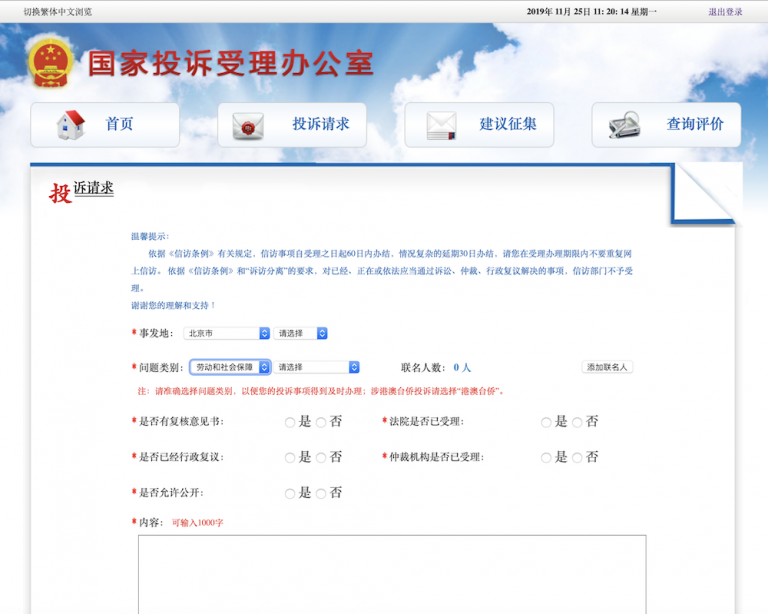
After registering on the above portal, you need to go directly to the complaints interface and correctly write it out.
事发地 – place of the incident.
问题类别 – type of question
联名人数 – if the complaint is not an individual, but a collective one, it is necessary to indicate everyone who is complaining along with you
是否有复核意见书 – whether there is a decision to review – in case of a resubmitted complaint
是否已经行政复议 – whether there is a decision as a result of administrative reconsideration by the relevant authority
是否许可公开 – whether to allow other users to view this complaint
法院是否已受理 – whether the complaint was accepted by the court
仲裁机构是否已受理 – whether the complaint was accepted by an arbitral tribunal
After all the checkboxes are checked correctly, the text of the complaint is written, the attachments are attached – you can submit and start waiting.
According to the 信访条例 (regulations for receiving applications from the population), the authority is obliged to accept the appeal and respond within 10 working days. 办结 (make a decision on the case) – within 60 days (in special cases – up to 90 days). After that, the authority is obliged to notify the applicant in a specified way. Most often this happens either by mail or in the status of the appeal on the website.
As mentioned earlier, each authority has 10 days to respond, that is, reducing the number of steps that the complaint will pass to reach the actual decision-maker is in your best interest.
The above website cannot do anything – it only redirects your appeal to an appropriate authority. In our example, the appeal was forwarded to the Ministry of Industry and Information Technology and to the Ministry of Labor and Social Security (another part of the question)
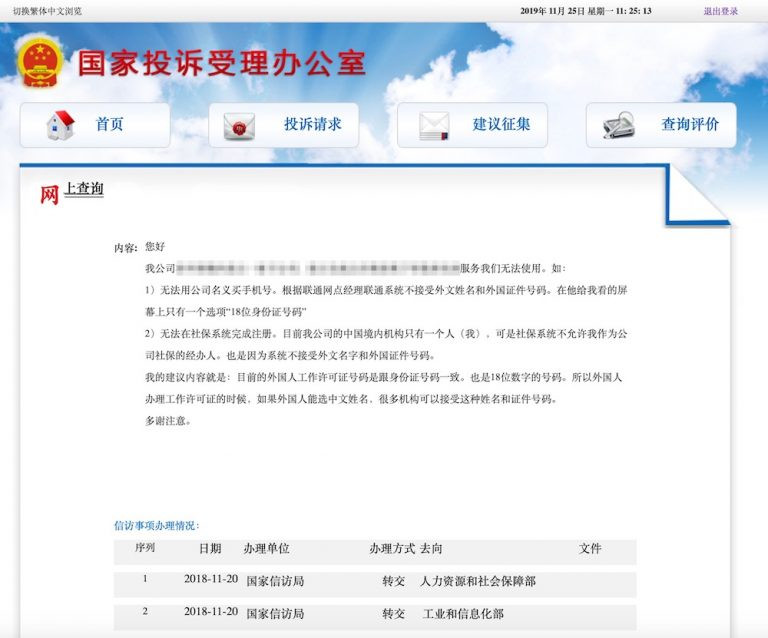
Approximately two weeks later (that is, exactly 10 working days), I received a letter from the MIIT stating that the telecom store was wrong and I can contact the telecom store for application.
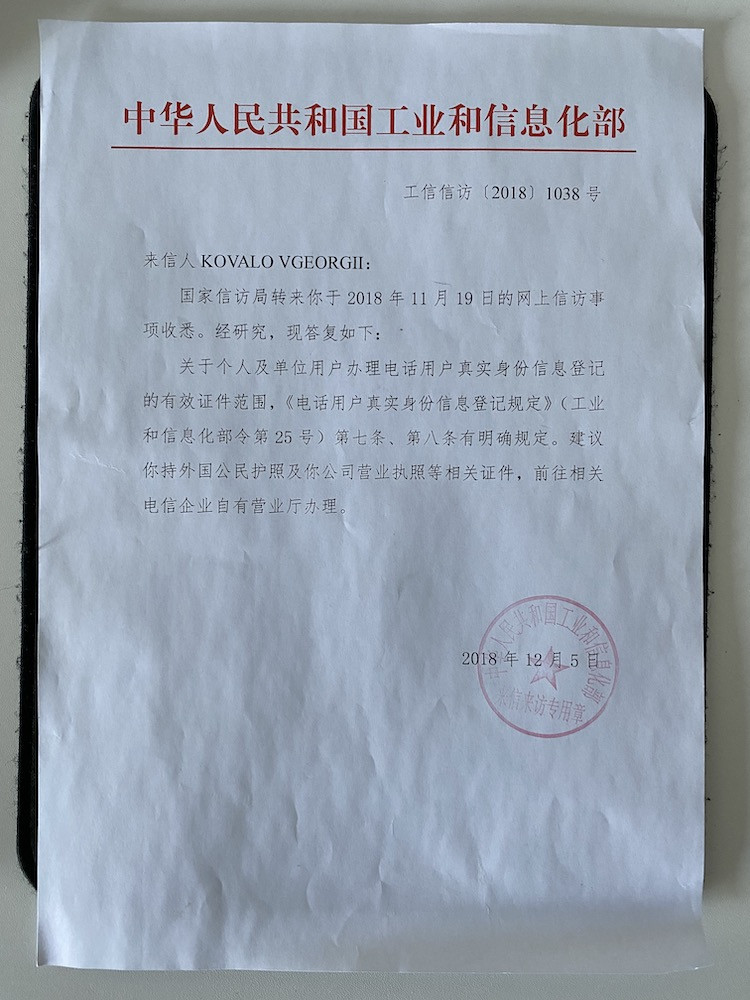
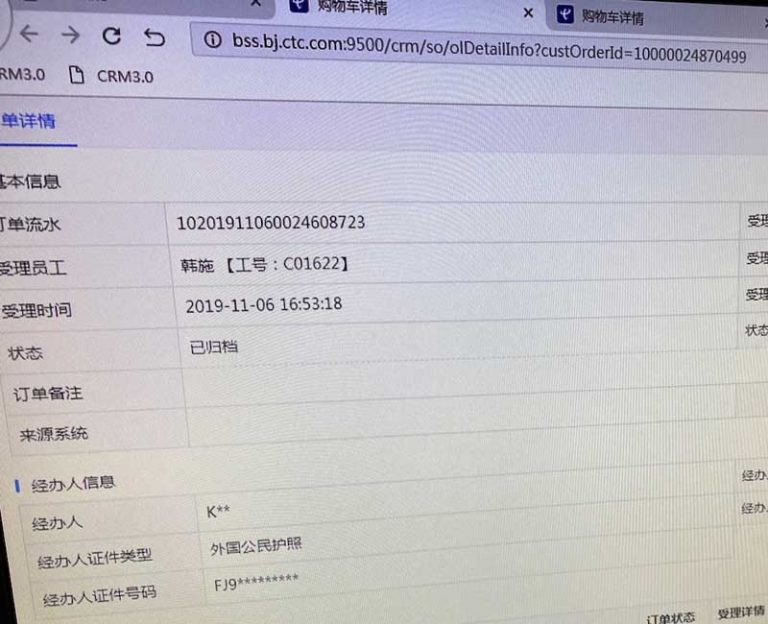
Did this affect the solution of the problem? It’s hard to say what exactly produced the effect, but when I went back to the telecom store with the same problem (carrying paper from the ministry above), I didn’t even have to show it, everything went like clockwork and the type indicated in the 经办人 document field was “passport of a foreign citizen”. That is, it was exactly what was required. And whether this complaint had an impact or it was just a coincidence – who knows.
So don’t be afraid to defend your legal rights – it’s easy and rewarding.