China's payment systems API
Although the 3rd party payments market in China is vast, every phone manufacturer, every mobile operator has their own e-wallets, and there are dozens of names in their ratings, it will not be an exaggeration to say that a consideration of electronic payment systems can be limited to two companies – Tencent and Alibaba. According to 3mbang data, Alipay accounted for 52.5% of the mobile payments market in 2018, while Tencent occupied 36.7% (in terms of the number of transactions made using mobile terminals). If not only telephones, but also all electronic devices are counted, the statistics look a little different – 44.5% for Alipay and 30.3% for Tencent. In any case, when thinking "I need to connect electronic payments", these two names will come up to mind of any novice (or advanced) entrepreneur. In 99% of cases this will be enough – whether we are talking about opening of a sole proprietor to sell shoes, a noodle stand on the street, or a high-profile website with millions of visitors. As for all other payment systems – yes, they are desirable, they have their own advantages, but the basic set is these two. Let’s now consider them in detail.
Naturally, the topic is too broad. And since over the years both networks have grown to the scale of huge, independent and backbone products (their importance for the existence of the state is evidenced at least by the fact that on the basis of WeChat – a mammoth messenger, which is the main tool for payments through Tencent – through a WeChat wallet a test run of an electronic identity card has been launched in some regions), we will not be able to boil the ocean. Each network has developed hundreds of related services – from food delivery and sale of discount coupons to investment platforms and credit bureaus. We will consider all this from the point of view of a novice businessman who realized that he was doomed to ruin without electronic payments in 2019. Let’s kick off here and then proceed further in coming articles.
So, WeChat offers the following payment solutions:
- 付款码支付 – payment by payment code. The user opens their WeChat on the page with a personal payment code (a barcode containing 18 digits or a QR code), the seller, by reading this code, charges the amount determined by the seller from the user's account.
Roughly speaking, this is a form that the seller sends to WeChat, and it is only the amount and the buyer's payment code that change in it every time. Accordingly, the danger of the method immediately becomes as clear as day:
- the buyer does not see the amount until it is charged
- having learned the payment code, an unscrupulous seller can at any time debit any amount from the buyer's account absolutely without their knowledge.
Nevertheless, since the code is one-time and changes with every launch of WeChat, and the notification of the debited amount comes in the same second, fraud with this type of payment is quite problematic. This method has taken root in almost all offline stores, self-service terminals at McDonalds and almost everywhere where a barcode scanner can be installed and where the buyer has physical access to it.
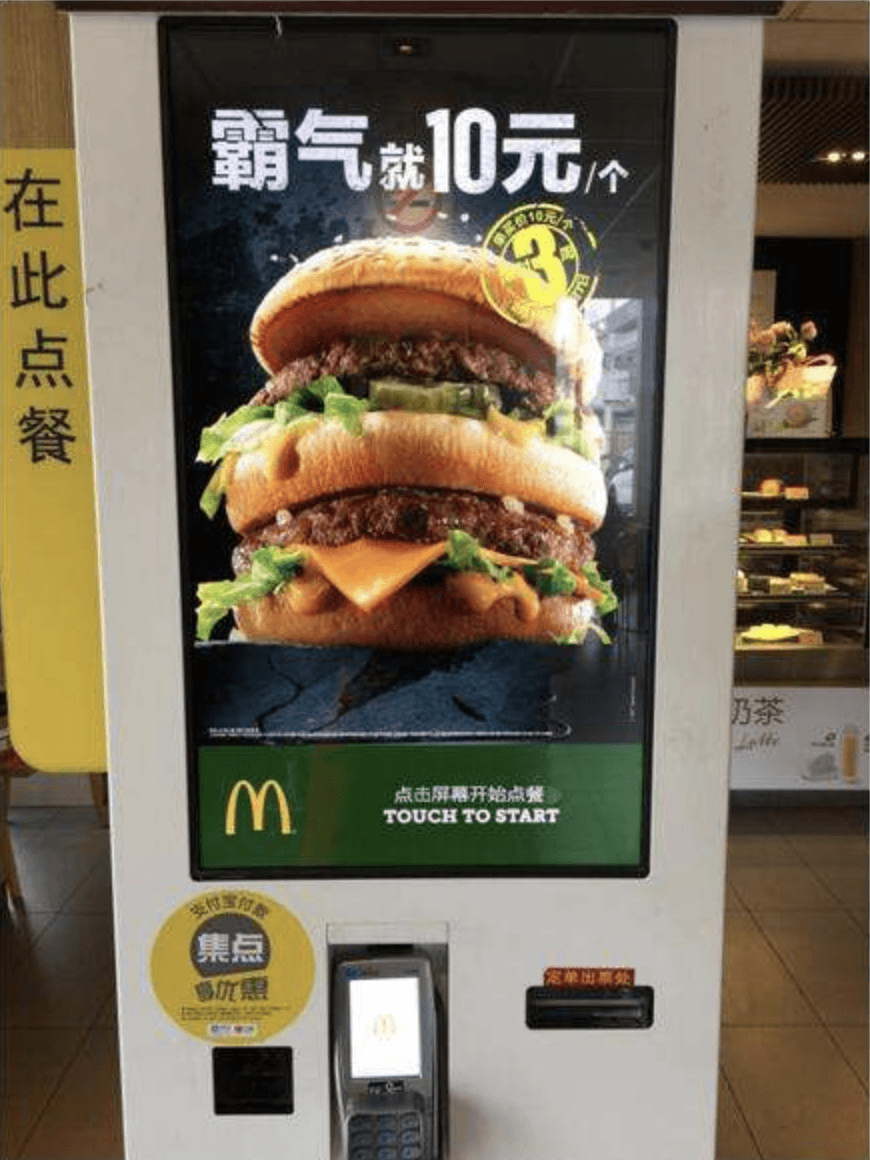
Self-service terminal at McDonalds. QR code scanner – black square at the bottom left.
- Native payments. The exact opposite of the first method, based on the fact that the seller generates a QR code with their data and the order amount, and the buyer scans it through their WeChat and confirms the payment. The advantages are obvious:
- the buyer sees the amount to be paid prior to the moment of payment
- all decisions are made by the buyer – s/he can refuse to pay even after s/he has scanned the code. The decision to scan/not to scan is also made by them.
This method has taken root wherever there is a screen that can display the updated QR code, primarily on desktop websites. It can also be found in places where there is a single mass product – for example, entrance tickets to Heaven Park are sold exactly through WeChat's Native payments.
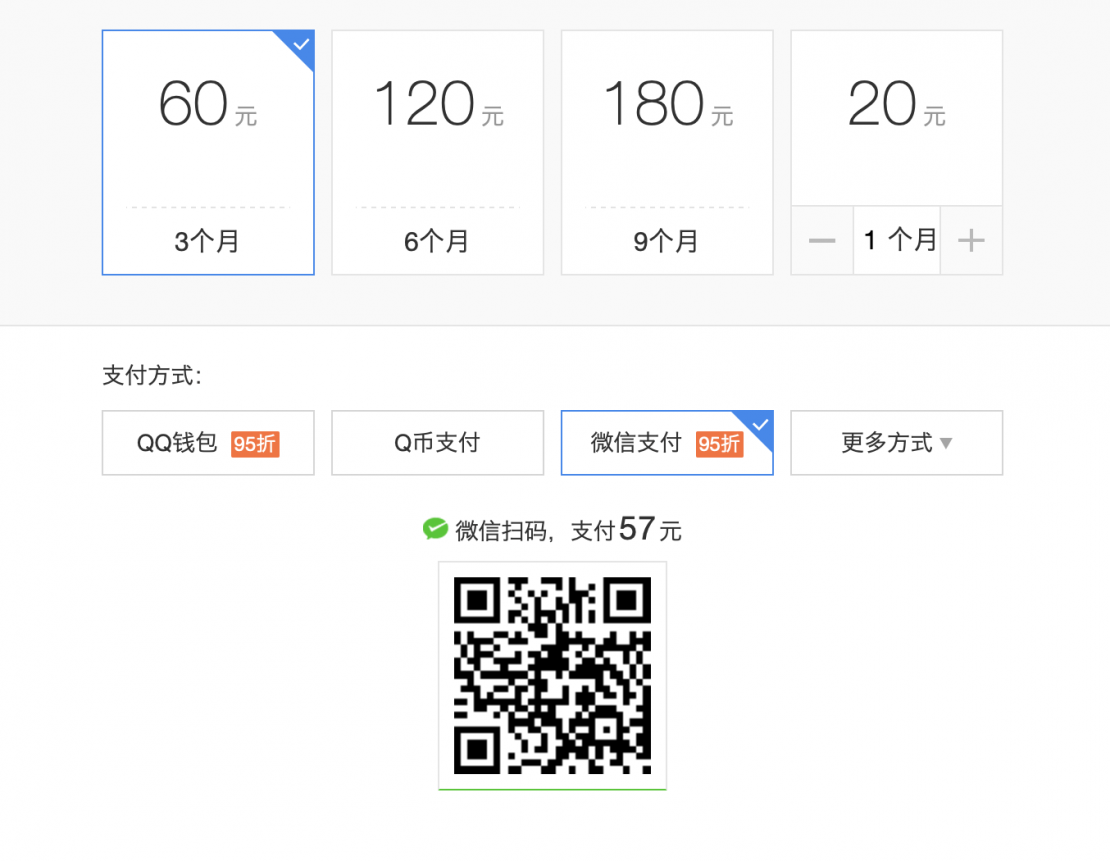
WeiChat native payments in Weiyun interface. Essentially, Native payments is a link in the format of weixin://wxpay
The disadvantages of both of the above methods are the complete lack of feedback and the inability to personalize payments for a specific user. That is, if we just sell entrance tickets, this is enough for us – we see the completed payment, tear off a paper ticket, and the next visitor comes up. But if we want to issue a personalized ticket to each user (drawing their full name from WeChat), then this would be impossible should we use such payment methods – the communication between the seller and the buyer ends at the time of payment for the order and its confirmation. And the maximum that the seller will see is the message that the user 123456789 at 12-31 paid 20 yuan to the seller 98765454321. Therefore, other types of payments are gaining popularity. But we will move on to them a little later.
- APP payments, or payments in third-party applications. Here, too, everything is extremely simple – the only scenario for using such payments is in mobile applications. Nestle's water delivery app, for example. The user orders water, clicks "pay", the Nestle application calls via Inter-app communication a WeChat application, in which the payment takes place. Upon completion of the transaction, WeChat sends a callback to the Nestle application and informs it that the payment for order 12345 was successful.
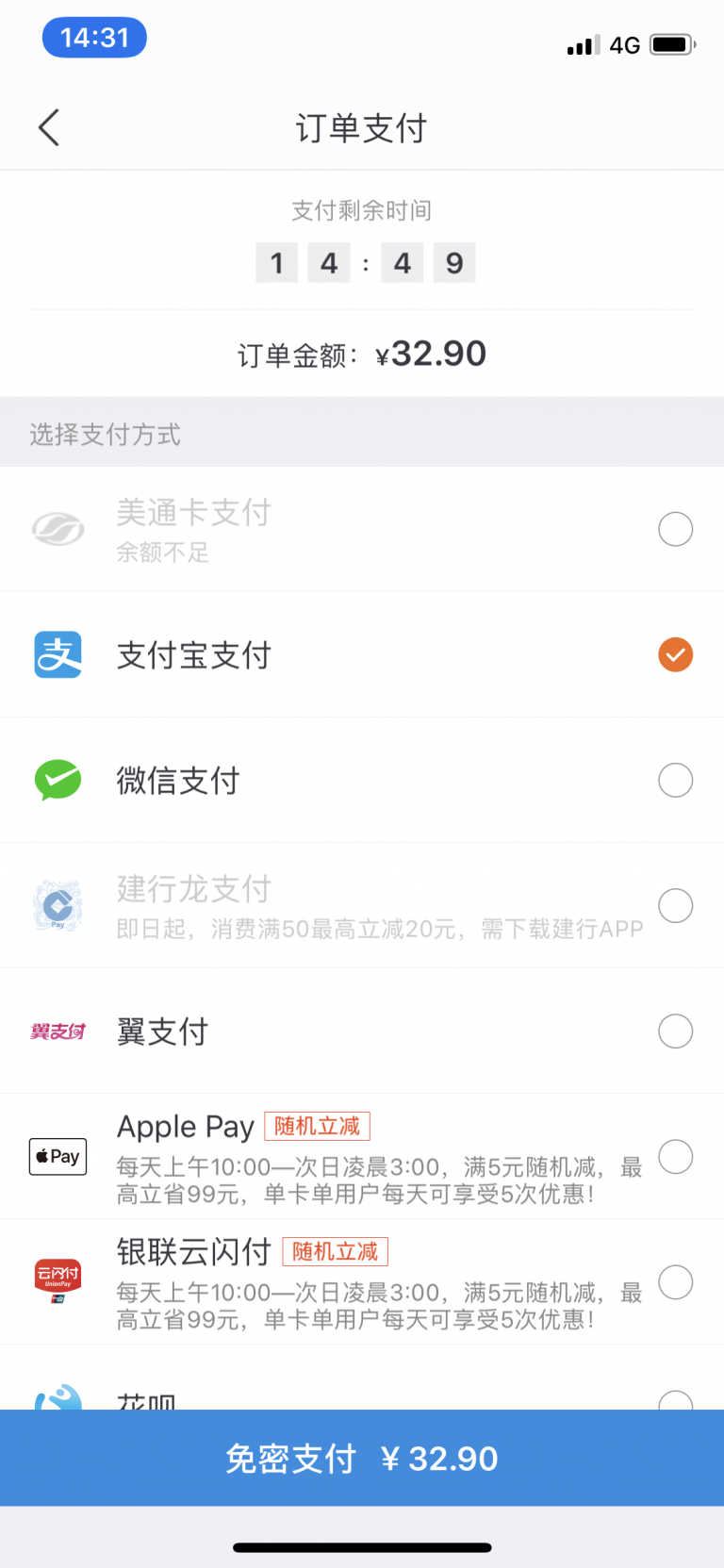
Choosing a payment system in the app for delivering goods from a supermarket 多点. It's all App Payment
- H5 payments. In fact, this is an updated version of Native payments. Since mobile traffic has been prevailing over desktop traffic for a long time already, and Native payments did not take root on phones for obvious reasons (mainly due to the fact that in order to scan a QR code with a phone, on the screen of which it is displayed, you need either a complex system of mirrors, or another phone, or a kind of an irksome exercise like "save the code to the album, open WeChat, select scan from the picture"), so H5 payments appeared. In fact, it's just a button on the product's web page, which offers to start WeChat when you click on it, and upon completion of the transaction, it gives a callback to the specified address on the Internet
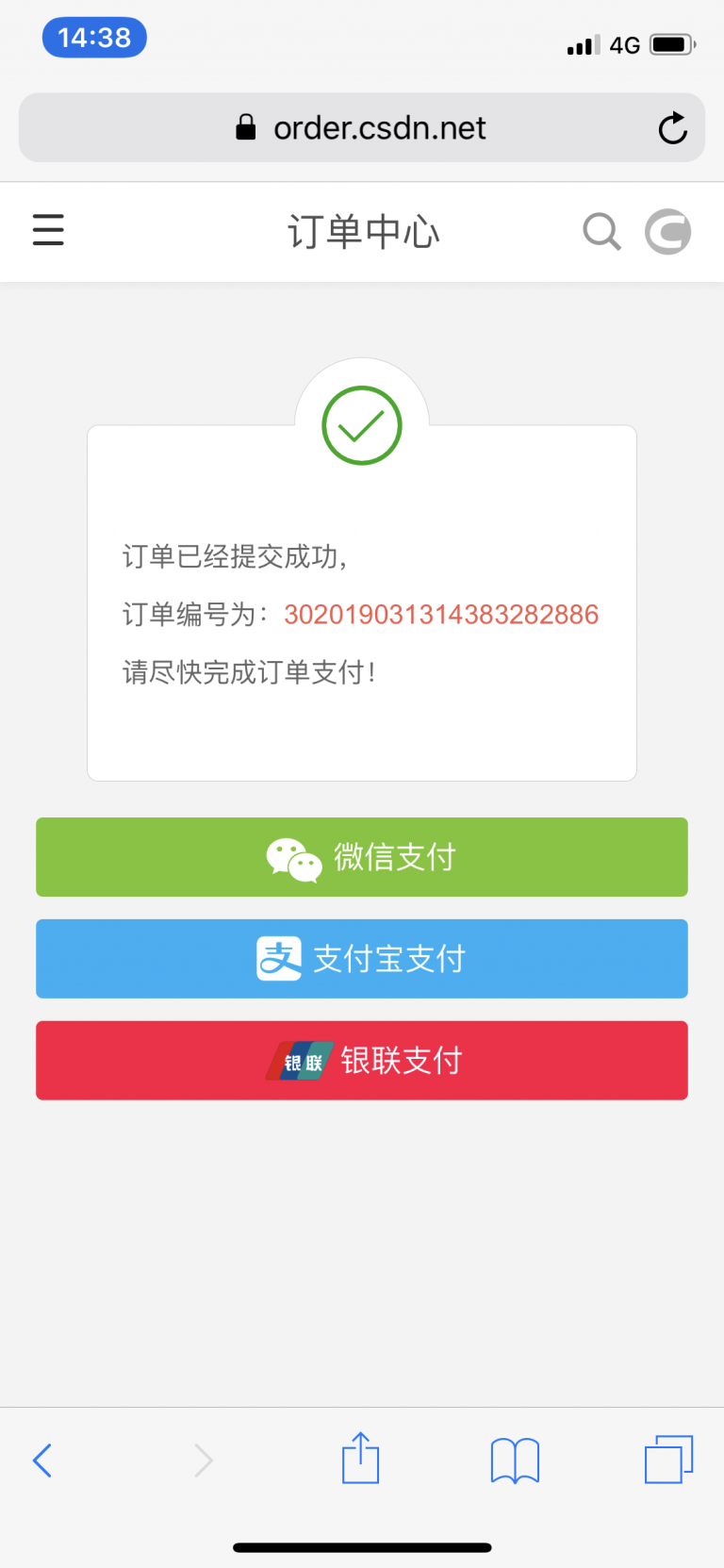
H5-cash register of the mobile version of the CSDN portal
- JSAPI payments. WeChat's first attempt to bring everything together under one roof and conduct all transactions in its built-in browser. It also supports the generation of codes for offline payments, and embedding into web-sites, as well as payment in public accounts. The attempt was a blatant failure and now can hardly be found anywhere. But it became a prelude for the emergence of small applications, which will be introduced in a moment.
In addition, of course, it is worth mentioning two types of payments that are not pure payments, but are also quite popular:
- payments-transfers. Especially popular with tangerine trolley vendors and street stall noodle vendors. They print out a personal QR code of the wallet owner, which can be scanned to transfer a certain amount. This is, in fact, illegal, prosecuted by tax authorities, and so on, because the license agreement explicitly states that transfers cannot be used for commercial purposes as well as to pay for goods.
- Payments through aggregators. If the seller is too lazy to register in each of the payment systems, s/he can register with an aggregator like iapppay.com, print out its QR code and hang it above the checkout / place it on the website. Well, of course, everything will now take place on the side of the aggregator.
Finally, the last and most enjoyable type of payments – payments in 小程序. In it can be roughly translated as "small applications". 小程序 are essentially web pages that only work from the built-in WeChat browser. Typical use case – a user scans a QR code via WeChat and gets into the application of a certain company. After that, this user’s WeChat is used as credentials for login, the developer has access to all the power of WeChat’s third-party APIs – to obtain information about the user, their geolocation, the results of analysis of preferences and hobbies, requests on the Internet, and so on – just too numerous to enumerate. In their application, s/he can implement absolutely everything, without any restrictions. And, accordingly, add payments in one click. That is to say, if all of the above methods have their own understandable limitations, conversion and retention in the application depends only on you. Many companies that started with simple applications have now grown into behemoths, in whose WeChat applications people spend more time than on any entertainment site. Possible examples of implementation:
- 小程序 KTV 同乐迪. Once you enter the room and scan the QR code on the table, you can order songs from the WeChat app, buy more beer, take part in a survey and get a discount, find like-minded people and lonely girls, and so on.
- barbecue 聚点串吧 – by going there and scanning the QR code on the table, you can go by without calling a waiter, but rather order meat in the application itself, take part in the "2 + 1" beer promotion, fill out information about yourself and get a birthday discount, exchange points for a discount coupon, etc.
Needless to say, the whole thing goes far beyond this. But the good news is that within any of the two platforms, you can tack on an infinite number of other related frills and functions directly to payments. Everything is about the same with Alipay, taking into account the difference that Alipay initially developed as a payment service (with later addition of social functions), whereas WeChat was originally a social platform, to which payments were later attached.
But in general, the two platforms are developing more or less evenly and the abilities are equal. We will talk about the intricacies of integration and connection next time.